
|

|
|

PROSTEP showcases its Expertise at numerous Events in the second half of the YearBy Joachim Christ Colleagues from PROSTEP's presales and sales departments spent a lot of time on the road in the second half of the year, presenting our comprehensive range of consulting services and solutions to customers and interested parties. Key events included DALO Industry Days in Copenhagen, the Scale MX conference in Hanover, Systems Engineering Day in Salzburg, the PLM Road Map & PDT Europe in Paris, Compit in Pontignano and Europort in Rotterdam. DALO Industry Days We participated in DALO Industry Days, hosted by the Danish Ministry of Defense, for the first time this year with the aim of underscoring the strategic value of our digital thread platform for the European and American defense industry. Our core areas of expertise such as PLM integration, digital thread/digital twin, secure data exchange and collaboration generated a great deal of interest in Copenhagen, and we were later able to meet with interested parties. Ultimately, all our solutions serve to ensure that companies in this industry are able to collaborate with partners in a secure manner based on mutual trust. 
Scale MX: Integration in data ecosystems We presented our solutions for integrating enterprise systems in data ecosystems at the Scale MX conference in Hanover and at the Software and Digitalization Dialog at the VDMA in Frankfurt under the heading "How do data ecosystems support collaborative engineering? The last mile has to be bridged". We showed what needs to be done to automatically import the data into the companies' backend systems or export it from these systems and thus ensure that users do not have to worry about the policies. A key aspect in this context is also the adaptation of business processes. 
Systems Engineering Day: Artificial intelligence and MBSE With approximately 300 participants and 20 exhibitors, Systems Engineering Day in Salzburg, which is actually held over the course of two days, is Europe's most important meeting place for the systems engineering community – a meeting of experts for experts – as Dr. Walter Koch, chairman of the Association for Systems Engineering (GfSE), pointed out. This year, the key topic was artificial intelligence (AI) and its significance for systems engineering, and for requirements engineering in particular. We demonstrated our AI-specific expertise in Salzburg with an AI-based chatbot that checks the quality of requirements based on predefined criteria and, following a successful check, automatically converts them into SysML V2 models that can be processed with editors commonly used for model-based systems engineering. 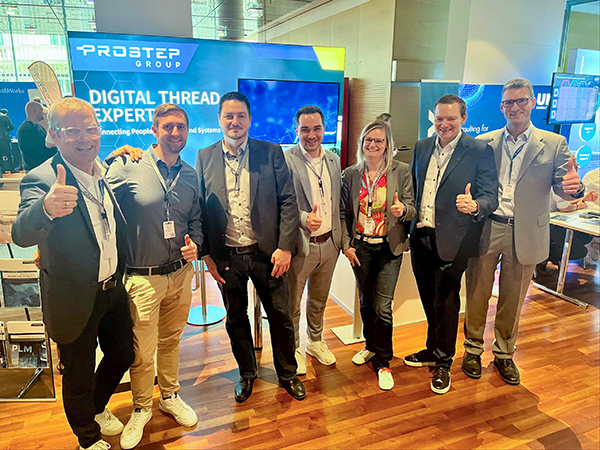
PLM Road Map: Digital thread/digital twin benchmark AI and the question of semantics in PLM infrastructures also played a major role at the PLM Road Map & PDT Europe in Paris, which as always generated a great deal interest from large-scale industry in France and the Benelux countries. A major highlight for us was the presentation of the results of the Aerospace & Defense PLM Action Group's digital thread/digital twin benchmark organized by CIMdata, in which we participated with our digital thread platform with great success. While other providers can only create digital threads in their closed system environment, we ensure cross-system interconnectivity. 
PLM Road Map: Digital Thread-Digital Twin Benchmark Auch auf der PLM Road Map & PDT Europe in Paris, die wie gewohnt auf großes Interesse der Großindustrie aus Frankreich und BENELUX stieß, spielte die KI und die Frage der Semantik in PLM-Infrastrukturen eine wichtige Rolle. Ein großes Highlight war für uns die Präsentation der Ergebnisse des von CIMdata organisierten Digital Thread-Digital Twin Benchmarks der Aerospace & Defence PLM Action Group, an dem wir mit unserer Digital Thread-Plattform mit großem Erfolg teilgenommen haben. Während andere Anbieter den Digital Thread nur in ihrer geschlossenen Systemumgebung aufbauen können, stellen wir die Interkonnektivität systemübergreifend sicher. COMPIT: Gaps in the digital process chains COMPIT is a globally recognized conference on computer applications and information technology in shipbuilding and serves as a meeting place for experts from shipyards, ship design offices, classification societies, universities and software companies. The second day of the conference was dominated by the topics OCX and CAD. Many participants in the OCX Implementor Forum were on site and presented the current status of their development. Numerous classification societies and software vendors have reached a level of development with which they can work productively. The industry, however, is still somewhat reluctant when it comes to passing digital models on to classification societies. Luckily, this applies to a lesser extent to the second software solution, which was presented by Joanna Sieranski from PROSTEP. The integration between NAPA Steel and REVIT allows the steel design to be transferred as a native REVIT model, which means that architects and equipment designers can work with the correct reference data. As the solution is primarily used within a single shipyard or between a shipyard and supplier, there is none of the reluctance seen when models are passed on to third parties. 
Europort: Digitalization underrepresented With over 1,100 exhibitors from 40 countries, primarily from the maritime supply industry, Europort in Rotterdam was fully booked this year. Surprisingly, digitalization played only a minor role at the event despite the fact that it is becoming increasingly important for the industry, not least because of the sharp increase in defense contracts. As one of the few exhibitors in the "Digitalization Area", PROSTEP showcased its credentials as the top address when it comes to digitalizing engineering processes in the maritime industry. We were able to establish interesting contacts with Dutch companies, which means that we have a good chance of further expanding our footprint in Holland. 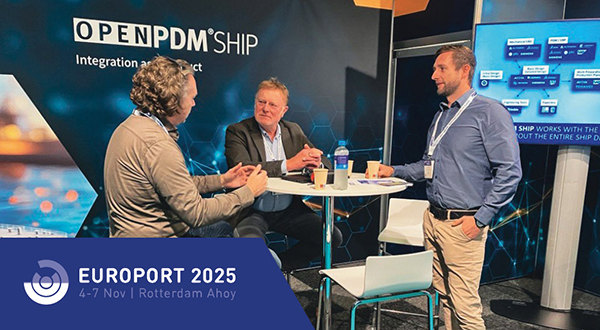
|
|
| © PROSTEP AG | ALL RIGHTS RESERVED | IMPRINT | PRIVACY STATEMENT | YOU CAN UNSUBSCRIBE TO THE NEWSLETTER HERE. |