|

|
|

PROSTEP TechDay at Volkswagen: Inspiration for InnovationBy Knut Stang The PROSTEP TechDay 2026 in Wolfsburg aimed to provide inspiration for innovation. Nearly 100 representatives from Volkswagen, suppliers, and software and consulting firms with whom we collaborate discussed the transformation of Volkswagen’s system and process landscape and the associated challenges in the event arena at the AutoVision Forum. 
The Volkswagen Group is currently energetically advancing to the next stage of evolution in its system and process landscape. This requires bold, innovative approaches. The goal of this year’s PROSTEP TechDay was to discuss such approaches openly with thought leaders from various companies. For years, PROSTEP has been actively involved with various teams in shaping the Volkswagen Group’s processes, not only within Group IT but also across several Group brands, primarily in Wolfsburg, Munich, Stuttgart, and Hanover. Our employees often take on the role of initiators of new and unconventional solutions. Dr. Markus Blum, Head of E2DT at Volkswagen, outlined the direction of this journey in his keynote speech at the start of the event. Blum highlighted the specific challenges and opportunities of the coming years: achieving a global development network, ensuring end-to-end data-driven processes, and modernizing the IT landscape in vehicle development are key objectives here. 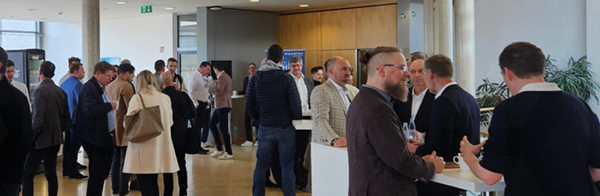
Based on this, two key themes linked the presentations by PROSTEP and our partners ABAT, Accenture, CONTACT, PTC, and UNITY at TechDay: First, the future role of artificial intelligence (AI) in various functions and roles, and in the medium term, the evolution of AI-based tools from aids to agents capable of autonomous design and decision-making. Closely intertwined with this, the growing importance of the Group’s linguistic integration—with its multitude of national and technical languages—became the focus of the discussion. For here, Volkswagen is gradually laying the foundation for comprehensive requirements management that will structure the entire vehicle lifecycle. To this end, PROSTEP has developed the key concept of the “Requirements Backbone,” which, in the context of MBSE and the Software-Defined Vehicle (SDV), will gradually replace topology as the guiding principle of the vehicle lifecycle. The basic idea behind this backbone is that, on the one hand, it fully describes the vehicle (and not just the differences from the previous model) and, on the other hand, that these requirements not only play a role in development but also structure and link the entire lifecycle, extending into the aftersales sector. This is because even in the after-sales phase, changes to replacement parts may arise due to new standards and regulations, which must be fed back into the Requirements Backbone to ensure the traceability of vehicle development. 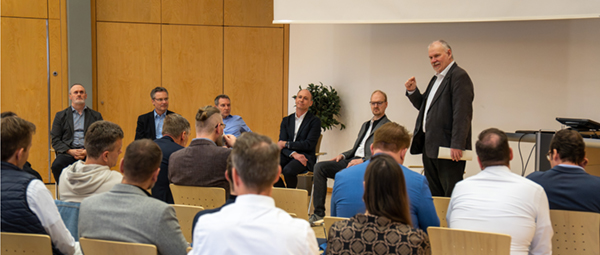
The presentations did not present final results but served as an introduction to open-ended discussions about the suitability of certain approaches, which are to be continued in the coming months and next year. Solutions were presented to overcome the linguistic limitations of LLMs, and prerequisites and necessary steps toward a significantly more integrated system and data landscape were discussed. At the same time, all discussions successfully linked the focused aspects directly to the current reality at Volkswagen, enabling concrete measures to already be drafted in initial outlines. In the concluding panel discussion, the question of what changes the processes at Volkswagen will face—primarily due to the growing importance of AI—played a major role. Both opportunities and risks were discussed here. The discussion participants agreed that without AI support, the Requirements Backbone would be difficult to implement, and that it is simultaneously a key driver for the targeted use of AI methods in the development process. However, the panelists also emphasized that the great opportunities offered by AI can only be harnessed if employees across the entire group are continually motivated and inspired by these opportunities, rather than placing the already controversial claim that AI will destroy jobs at the center of the transformation process. The goal of the PROSTEP Techday was to create ripples and the event succeeded in doing so. The new format, featuring short presentations and longer discussions, was very well received by the participants. The innovative approaches presented in Wolfsburg are to be further discussed and explored in the near future. 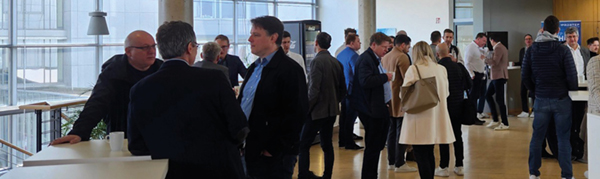
|
|
| © PROSTEP AG | ALL RIGHTS RESERVED | IMPRINT | PRIVACY STATEMENT | YOU CAN UNSUBSCRIBE TO THE NEWSLETTER HERE. |